
An FSRC Public Utility Labs Product
Know the rule. Prove the origin. Trade with confidence.
Practical tools for small and medium manufacturers to determine CUSMA / USMCA / T-MEC origin, see what the duty benefit is worth, keep the evidence ready for customs, and prove it to buyers with a verifiable Origin Passport.



Six products, one deterministic engine

 Open RulebookThe product-specific rules the engine applies, with the official text in English and, where the source provides it, in French, their source and version history. The interface is in English, French and Spanish; the rules have no official Spanish text in the source used.
 Tariff WeatherWhat qualifying is worth, by product line and lane, updated as measures change.
 Origin WorkspaceYour end-to-end origin workflow: bills of materials, confirmed facts, determinations, certifications and the evidence vault.
 Origin PassportA reusable, signed certificate of origin your buyers can verify online in seconds.
 Broker DeskTools for customs brokers and agencies: client workspaces under consent, review queues, white-label reports.
 Buyer VerificationCheck and monitor supplier passports at volume, measure coverage, and pull them into your own bills of materials.
How a determination is made
- 1Classify the goodHS code and lane confirmed by you.
- 2Find the applicable ruleFrom the published release, cited to its source.
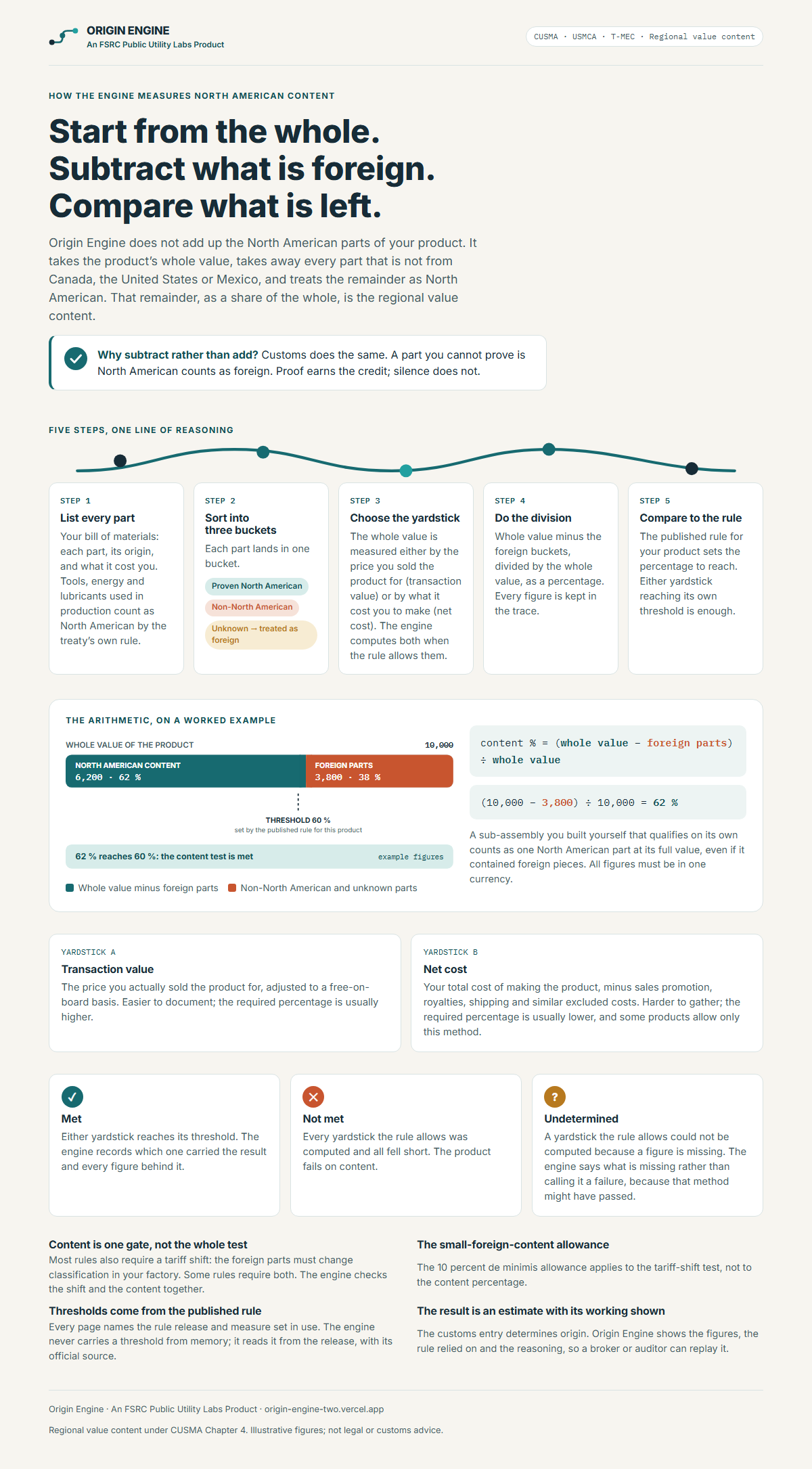
- 3Apply it to your inputsTariff shift, de minimis and, where the rule requires it, regional value content: each step traced.
- 4Conclude and keep the proofResult, explanation and evidence stored with the rule release, measure set and engine version used, so a stored determination can be replayed. A withdrawn release is no longer served publicly.
Built for people who answer to customs
- Deterministic: the same inputs and the same rule release give the same result, every time.
- Every result names its rule release and measure set, and its working is shown in full.
- No tracking cookies, no analytics; customer data stays in Canada.
Create an organisationExporters, producers, brokers and customs agencies.
Results come from the CUSMA rule release and measure set named on each page, approved and released by FSRC; each rule’s review note says whether a licensed reviewer has read it. Duty figures are estimates, and the determination of origin is made at the customs entry.
Rule release cusma-annex4b-2026-11-r5 is served: 3,090 rules, 1270 of them with a regional value content requirement; 62 provisions of Annex 4-B it does not carry yet, for which the engine gives no result.